

05/11/2026 0 Comments
Creation Care Eco Blog
Creation Care Eco Blog
# Notices

Creation Care Eco Blog
5 November 2026
Do you buy herbs in pots from the supermarket? If we keep them in a well-lit place and water them as they need it, it can be a very good way of keeping your kitchen supplied with fresh herbs, especially if you are short of space to start seeds off. And you have a pot to re-use once the plant(s) are finished. But we've probably all observed that the plants are very crowded in there, and that doesn't always make for good plant health. Some people suggest that you split the plants up into several pots as soon as you get them, but sometimes the plants are already a bit tall and leggy for that to be successful. I tend to use them for as long as possible and then......I plant them outside (apart from basil, unless it's summer). A couple of years ago we were going on holiday and I had a supermarket parsley which was past its prime, but still had potential. Not wanting to chuck it in the compost bin, I just teased the roots apart a bit and stuck it in a planter by the front door. When we got home, not only had it survived, it had thrived, and kept us in parsley almost until New Year. The eco bonus was that I also saved money and didn't use so many pots or the plastic bags the plants come in. Now I always do this when I have to buy a new plant. The old one goes outside. This year when we went on holiday, it was a coriander plant that went outside. Again, it thrived. I know it's been very mild, but here we are at the beginning of November, and it's still thriving. People who come to the house notice it and say 'Is that coriander?' in astonishment. It will shortly be joined by some parsley and we will see how they do in the coming weeks.
Do you remember the 'labels' we wrote at the Harvest Lunch? I sent them all off to Transform Trade the same day. Here's an update on their campaign:
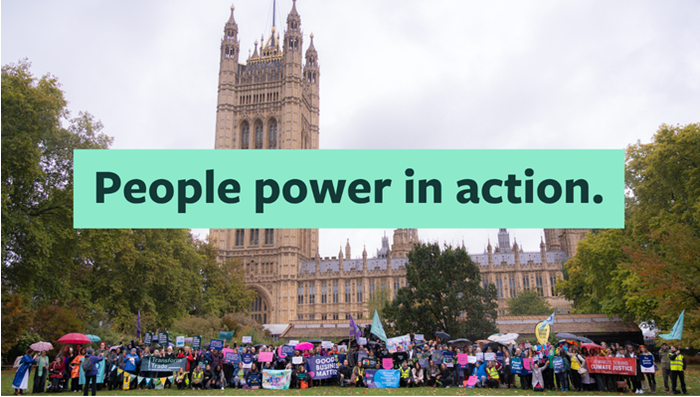
Yesterday we joined campaigners from across the UK at Westminster for the Good Business Matters mass lobby of Parliament - calling for a stronger law to stop businesses profiting from harm.
It was a real pleasure to have Transform Trade supporters there, standing alongside people from across the country as part of the Corporate Justice Coalition to make the case for change. Thank you to everyone who came along, met with their MP, helped spread the word or supported the campaign in other ways.
Here’s what we got up to.
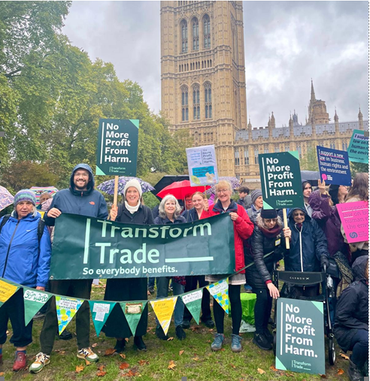
Taking our message to MPs
Transform Trade supporters and staff joined several hundred campaigners at Westminster, alongside organisations including CAFOD, Friends of the Earth and UNISON, to call for a strong UK Business, Human Rights and Environment Act that prevents harm and holds businesses accountable.
Through our ‘The Labels We Want to See’ action, more than 250 groups created labels calling for businesses to put people before profit. We took hundreds of these to Parliament to help make our message heard. Thank you to everyone who took part!
A step forward - and we're not stopping here
The lobby showed the power of people coming together for change. 135 MPs either met with constituents or received requests for meetings, and the number backing the Good Business Matters pledge rose to 99.
Now we need to keep building pressure on the Government to deliver a strong law that protects people and the environment.
9 October 2026
I wrote a couple of weeks ago about the recent death of Wendell Berry, and the impact of his writing, even when one didn't actually know the writer. I was reminded this week of another loss over the summer, that of Carlo Petrini, founder of the Slow Food movement. He's not known as a theologian, but he understood and communicated the need for us to slow down and give attention - to ourselves, our inner lives, our environment and, of course, what we eat and how it's produced. He took up Wendell Berry's phrase 'Eating is an agricultural act' and took it to another stage - 'Eating is an agricultural and political act'. I left you to ponder the first statement for yourselves a fortnight ago, but I think this merits a little more unpacking. Eating is an agricultural act, where we are participants in the whole process, thinking about where our food comes from, how it got here, treating it with the respect I deserves when we prepare, cook and eat it. And as Christians, being mindful and thankful for God's goodness towards us. But eating as a political act? There are many ways in which this can impact us. Being thankful for our abundance and the fulfilment of our needs should make us mindful of the lack of abundance suffered by others, either directly in the supply chain of what we eat, or others who suffer deprivation or want for any reason. And that should move us to action.
Following on, eating is also a political act because our choices affect supermarket policy and ultimately may affect government policy. Particularly if we back up our choices with a letter or email to the supermarket cafe chain about why we did or didn't buy a particular product. Or if the circumstance warrants, even write to our local council or MP.
We as consumers have choice, and therefore power. So, the agricultural act, political act, ultimately becomes a theological and spiritual act.
2 October 2026
With Harvest Thanksgiving this Sunday, I thought this week would be a good time to revisit some of the suggestions made at last year's Harvest Lunch. I'll concentrate on the church-related ones this time and look at the lifestyle ones on another occasion.
Please note - there's no particular order to these, it's just the way they originally came out of the envelope!
1) A noticeboard for eco matters. This is a great idea, and it was pointed out to me that one or two of the noticeboards in the hall are not being used. But a decision needs to be made about transferring responsibility for a particular board, and making sure all stakeholders are in agreement. We will revisit this in the next few weeks.
2) Separate ideas and actions specific to children and adults. A bit more input about what this means in terms of context and action would be useful
3) A weekly contribution to the newsletter. If you are reading this, you will be aware that we took this forward as more of a blog, with material for reflection as much as suggestions or 'advice'. I had to take a bit of a break over the summer because of family commitments, but hopefully we're back on track now.
4) Eco-friendly cleaning products for church and kitchen. If the person in charge of purchasing these would like to get in touch, we can have a conversation.
5) Children asked that we have a regular prayer in church every week for the planet. Prayers for the environment are regularly included in the intercessions, although not every week, but of course the young people are not generally in church at that point. Are prayers for the planet included in young church? Maybe we could include a short prayer, which we could all learn, alongside our Trinity prayer each week.
6) Several people, understandably, mentioned solar panels. Dear friends! I wish I could adequately convey to you how many hours of research and discussion have already gone into this. Suffice it to say that the situation is extremely complex and we will continue to investigate.
25 September 2026
I was saddened to hear of the death at the end of August of the writer and poet Wendell Berry. James Rebanks wrote of him 'Wendell Berry is the most important writer and thinker that you have (probably) never heard of'. In his late 20s he left a successful and secure academic career in New York to return to his roots in rural Kentucky, where he continued both to write prolifically and farm the land in as non-interventionist a way as possible, using horse teams and minimal ploughing rather than tractors.
I confess that, until recently, although I was aware of him and his influence, I'd read too little of his work. I'm putting that to rights now. But I would like to offer you couple of quotations from my previous readings, and one from an essay I'm reading now. Firstly, from the 1968 essay 'A Native Hill':
'There appears to be a law that when creatures have reached the level of consciousness, as [humans] have, they must become conscious of the creation; they must learn how they fit into it, and what its needs are, and what it requires of them, or else pay a terrible penalty: the spirit of creation will go out of them, and they will become destructive; the very earth will depart from them and go where they cannot follow'.
The second is from his poem 'How to be a poet', quoted on several occasions by Malcolm Guite in his Church Times column, most recently in the 18th September issue (the whole article is well worth reading):
'Make a place to sit down.
Sit down. Be quiet.....
...Shun electic wire.
Communicate slowly. Live
a three-dimensioned life;
Stay away from screens'
The third quotation is the shortest, but bears thought and reflection. It's from his 1989 essay 'The Pleasures of Eating'. The whole essay is, of course, worth reading, but I leave you with this single thought:
'Eating is an agricultural act'
1 May 2026
What's a weed?
One definition of a weed is simply a plant that's growing where WE don't want it. My neighbour got quite umpty about something that had made a transition from my garden to his (all by itself..), until I told him it was an allium christophii and people pay good money for them....
But I was just reading something this afternoon which I'd like to share with you. Perhaps it might make you have another think about 'What's a Weed?'
"Wherever ground was disturbed or neglected, the first green notes of recovery rose in the same ancient sequence they always had. Dandelion eased open the soil that had been pressed too long beneath weight and worry. Bramble cast their thorned mercy across exposed earth, shading it from burn and dessication. Willowherb drifted in like a pink exhalation, clothing the wounded places that human industry left behind. These were not weeds but Britain's oldest physicians, the first healers to return whenever the land is hurt, pioneer species who carry the first sparks of resilience. "
'Lost Wildness': Brigit Anna McNeill, Permaculture, issue 127, Spring 2026, pp4-5
17 April 2026
Think you haven't got room for a tomato plant? Think again!
If you were watching Gardener's World a few weeks ago, you may have seen Lance Turner from Tomato Revolution talking about (you guessed it!) tomatoes! And he showed some very dwarf varieties which you can even grow on a windowsill, or the smallest balcony or patio. I already have some seeds for these types and am planting them now. In a few weeks I'll have some plants to give away after church. Some will grow maximum 6 inches (yes, really) and some 12. If you grow plants from seed and have more than you need, as often happens, maybe we can have a plant swap time after church.
Also to note that this coming Wednesday is Earth Day. Think about what you might do to mark this and really think about how we are part of God's creation. Earthday.org
31 March 2026
Did you see the programme about bees on BBC 4 this week? It's well worth catching up with. I thought I knew quite a lot about bees, but I really learned a lot. You can catch it on iPlayer (other streaming services are available!). The full title was 'My garden of a thousand bees'.
Whether or not you watch(ed) it, perhaps you will be inspired to plant some more pollinator-friendly plants in the garden this year. And if you don't have a garden, perhaps you have a balcony or some space where you could do something. If you grow things from seed, maybe you could plant a few extra and bring them to church for others. Or however small your space, try growing a few things from seed just in a pot.
If you're not sure what to grow that's pollinator-friendly, have a look at the RHS Plants for Pollinators list - https://www.rhs.org.uk/science/research/plants-for-pollinators . So many ideas here, whatever your tastes, or space available, or gardening experience.
20 March 2026
Here are some tips from Climate Stewards this week. For more information, visit their website https://climatestewards.org/ .
| |
|
Seven tips for wasting less energy
|
|
| |||||||||
|
| ||||||||
|
13 March 2026
There have been a few interesting stories in the news this week, a bit of a relief from the situation in the Middle East.
First off, a project, backed by the local council in Hounslow, to cultivate unused land in the area - https://www.bbc.co.uk/news/articles/cy7j3g3n2lxo
Second, what do you think about the proposal to feature pictures of British wildlife on the next series of banknotes? Might it raise awareness? https://www.bbc.co.uk/news/videos/cn714mxj85ro
And Bishop Graham Usher, Bishop of Norwich, and the Church of England lead Bishop for environment and biodiversity, has been named on the top 100 list of climate and environment leaders in the UK, which is great recognition of the work the CofE is doing, but there's so much more to be done. https://www.dioceseofnorwich.org/bishop-of-norwich-on-top-100-climate-leaders-list/
6 March 2026
Amid all the other business at General Synod last week, a potentially quite significant motion was approved, relating to church flowers, and how our use of flowers in church should reflect our commitment to creation care. I'll quote the text of the motion in full:
The motion read:
That this Synod
(a) embrace the principles of the Sustainable Church Flowers movement which encourages a living into the Fifth Mark of Mission by promoting the use of local, seasonal and fully biodegradable compostable flowers and foliage;
(b) encourage cathedrals, churches and churchyards — wherever possible — to source flowers and foliage locally and seasonally for use in worship and church life;
(c) call on cathedrals, churches and churchyards to eliminate the use of floral foam (oasis) and all similar non-biodegradable and non-reusable products and techniques, while rediscovering traditional and environmentally friendly methods of presentation and display.
It is important to notice the language here. Sections a and b talk about 'promoting' and 'encouraging' a move towards using more sustainable, locally grown and/or seasonal flowers and foliage in our church displays. And some churches will be able to make that move more quickly and easily than others. Section c, however, is an unequivocal call for the complete elimination of the use of floral foam (oasis) as quickly as possible. If you're in any doubt as to why this is necessary, please have a look at this article, and particularly the video link at the end - https://www.sustainablefloristry.org/resources/floral-foam-facts/ The scientific article underpinning this can be found here - https://www.sciencedirect.com/science/article/abs/pii/S0048969719358218?via%3Dihub (nb this is not the complete article, but a full summary and abstract).
Finally, just to note that Big Plastic Count starts Monday 9th March. And it's not too late to sign up! https://thebigplasticcount.com/
27 February 2026
Last Friday (20th February) was the International Day of Social Justice, so there's been an abundance of reports to choose from, to highlight for you this week. And it should remind us that social justice and climate justice are inextricably linked. But I will just stick with one of those reports, and get to it a bit later.
But first, do you enjoy making and/or mending things? There's no doubt it's good for our mental wellbeing, and can be good for the planet too. If you would like to be able to do more - darn socks, for example - then other folks in our community would love to share their skills. What could we arrange?
I was particularly put in mind of this when I read the following in an article this week:
'One of the most beautiful things about sewing or making is the connection you create between yourself, traditional knowledge and the person or people who are sharing their knowledge with you. Ancestral space is created in those moments; relations become threaded across time between your ancestors, your present and your descendants through the act of sewing or making cultural materials.'
Threading Ancestral Spaces by Krista Ulujuk Zawadski (Inuit Art Quarterly: December 2025)
In case you're wondering how I came to be reading what would seem to be a fairly obscure publication, it's because, thanks to Pressbooks, I can. Many local authority library services subscribe to this, and it's an absolute treasure trove of UK and international magazines and newspapers, all freely available online via your library service. There's got to be a green message in there somewhere. It's certainly a potential money saver, and a huge window on ideas.
Finally, going back to social justice, reports and the clothing/fashion industry... (and there is a clear link here, because making and mending reduce our dependence on continuous replacement), the report below came out this week. Not focusing on the industry's bad faith relations with overseas suppliers, particularly in the global south, but highlighting that the same issues and injustices are visited on UK suppliers too. Transform Trade have published other reports dealing with the situation in the global south, which I'm sure you can find if you want to follow this up.
https://www.transform-trade.org/fashion-watchdog-2026?mc_cid=2bfb56222f&mc_eid=b75d581f33
18 February 2026
Cast your mind back to the suggestions made at Harvest Festival.... Some of them involved the hall kitchen, and there are certainly things we can do to improve our environmental footprint there. But during rehearsals for 'Captain Noah', someone reminded me that sometimes individuals can just get on with it, and not wait for someone else to organise things. One of our refreshments stalwarts, who was, I think, at every rehearsal, and must have made literally hundreds of cups of tea and coffee, gathered up all the used tea bags, took them home, and put them in their own food waste bin. They also gathered up all the plastic wrappings from the cakes and biscuits and took those to the plastic recycling at the supermarket. No need to wait for an 'organised' collection. Just did it. So can we all.
Lent is already upon us. If you're still looking for a positive Lent challenge, it's not too late to sign up for A'Rocha's Carbon Fast - https://arocha.org.uk/carbon-fast-26/ . Plenty to think about, and maybe do, during Lent and beyond.
6 February 2026
A belated happy new eco-year to all. Here are a few things to think about or do this week:
First - why not download the A'Rocha Easy Eco Tips calendar and stick it up in your kitchen? https://arocha.us14.list-manage.com/track/click?u=69f4c1083320061706fe47874&id=7fa67acdd9&e=3b5ff2b9e6
Second - the government has just published a long awaited report into biodiversity loss and ecosystems, and how this affects our national economy (in the narrow monetary meaning of the word) and even national security. Not an easy read, and I confess I need to make some time to really get to grips with it. https://www.gov.uk/government/publications/nature-security-assessment-on-global-biodiversity-loss-ecosystem-collapse-and-national-security
Third - something quick, easy and positive. Why not sign the RHS petition to help speed up the banning of the use of peat in horticulture? If you're not already up to date with why this is important, please read the article first before clicking through to the petition. https://www.rhs.org.uk/advice/peat/peat-free-petition
Finally, why not sign up for the 'Big Plastic Count', which happens in March. Just count all the pieces of plastic you need to get rid of in the week, whether they go for recycling or not. All instructions when you sign up! It's fun, and very enlightening. https://thebigplasticcount.com/sign-up
12 November 2025
Have you been watching the Doctor Who spin-off 'The War between the Land and the Sea' ? I promise, no spoilers if you haven't caught up yet. But I'm engrossed. There's a very strong eco message and I'm fascinated to see how the story develops. And if we could communicate with the inhabitants of the oceans, what do you think their message to us would be? Something very similar to Salt's message to the inhabitants of the land in the story, I think.
Do you have Christmas lights decorating the outside of your house? For many people, young and not-so-young, it's one of the joys of the season to see what folks have done with their outdoor decorations. And, as a child, it kept me and my brother occupied in the car, with our Christmas tree counting competitions during those December trips to visit relatives all over West Lancashire. But if outdoor illuminations are your thing, take a cue from the church December floodlights, and turn them off before you go to bed. The natural world needs those hours of darkness to function and/or to rest. And it will make a difference, even if you have streetlights directly outside your house.
21 November 2025
Church suggestions:
Two things this week, one from the Harvest festival suggestions, one mentioned at church recently.
In the Harvest festival suggestions, some of children said they would like to have prayers, or a prayer for the environment every week. This is a great suggestion, but where/when should we have them? There are several options - we have an environment prayer with the 'sending out' prayer, there's an environment prayer with the young people while they are in the hall, or we have that prayer once the young people are back in church. What do you think? And particularly, what do our young people think?
The second item was about Christmas cards: it was suggested that people might want to consider not sending cards people they see regularly, and make a charity donation instead. No-one is suggesting we don't send cards to folks we don't see regularly - that's one of the joys of Christmas. But it's something we might want to think about, while considering both sides of the coin. Not sending cards to people we see often, but making a charity donation instead has merit, as long as folks know what we're doing and why. Sending cards that support your favourite charities even to people you see often perhaps promotes that charity just a bit more to those people. And some people just love writing cards, no matter how many! Have a think, and make your own decision.
14 November 2025
Shifting baseline syndrome
It's really easy to forget how things change, and think we aren't making an impact where it matters. This article from 'The Conversation', an online academic news journal, helps us consider how things have changed and, yes, progressed in the last 10 years or so. https://theconversation.com/the-un-climate-summits-are-working-just-not-in-the-way-their-critics-think-268953
But there's still a long way to go. What's our reaction to the people who invaded the COP30 talks in the week? It certainly made the news - https://www.bbc.co.uk/news/articles/c0l7yjgn050o
While we continue to think and pray about these things, perhaps God is speaking to us about what we can do. Not suggesting we gatecrash talks in Brazil or elsewhere, but is there action we can take? Signing a petition, or writing to our MP, perhaps. Something to ponder this week.
7 November 2025
Citizen science can really make a difference in small and large environmental projects, ensuring that local communities have a voice in projects that should benefit them. But how surprised are we when that doesn't happen?
Click here for an article from the Resurgence Trust.
COP30 starts on Monday. If you would like some ideas for how to pray about the process, this website might be helpful - https://www.cop-prayer.uk/
24 October 2025
Some of the suggestions we collected at the Harvest lunch were around kitchen waste at church. We'll definitely be looking into the logistics of the suggestions, notably for food waste and soft plastics. In the meantime, let's make sure we're on top of this at home, or even at work, making sure that all our food waste goes in the correct bin. If we're at work, and our employer doesn't provide food waste collection facilities, do you have the opportunity to make a suggestion? Otherwise keep a suitable container at work and bring those pesky teabags, apple cores, etc home with you.
If you were at the harvest festival service, you may remember that I talked about the Vatican putting solar panels on its buildings. It was announced this week that a major installation has been completed on Vatican owned property near Rome, and consequently, the Vatican joins a very select and small group of countries (8) that get 99.7% of their energy needs from renewables. And that's even without putting solar panels on the roof of the Sistine Chapel! Read more here: https://happyeconews.com/countries-running-on-renewable-energy/
17 October 2025
Many thanks to everyone who contributed ideas about how we as a church community at Holy Trinity can all become Creation Care Champions. There will be more information and responses coming in the next few weeks, but one of the ideas was to have a weekly section in the newsletter.
The A Rocha 'Eco tips Calendar' (link below) for October encourages us to think about seasonal food - which fruit and veg are at their best in the UK right now, and can we get them at our local supermarket? It's the season for UK apples, with both traditional and new varieties in many shops now. Watch out for traditional varieties Early Windsors, Egremont Russets and Cox. If you've never tried an Early Windsor, they really are a treat (but they do bruise easily, so be careful!). If the supermarket where you shop doesn't have new season UK apples, ask them why. Maybe even write to customer services if the Branch Manager doesn't have a good answer for you.

Comments